Research Legacy

On the Use of Metaphor, Simile, and Analogies
(Source: Business Perspectives on Construction Management authored by Dr Vasantha Abeysekera)
The reflective use of metaphor as discussed in the book on Business Perspectives in Construction Management authored by Dr Vasantha Abeysekera is not a stylistic device introduced for narrative appeal alone. It is grounded in a long-standing methodological approach that has evolved through the author’s doctoral research and subsequent scholarly work, where metaphor and simile were employed as analytical instruments for understanding, synthesising, and resolving complex construction phenomena.
This approach first emerged during the author’s doctoral research, which explored Brickwork as Chaos (Abeysekera, 1997). In that study, chaos theory was used symbolically to understand and manage what appeared to be “chaotic” brickwork production. Fundamental concepts from chaos theory, such as universality, the geometry of order, and pattern formation, were not used merely to describe observed phenomena, but to identify pathways for intervention and control. The metaphor was therefore solution-oriented, providing a lens through which disorder could be rendered intelligible and manageable.
This methodological stance was subsequently extended into a keynote address and contractual research, most notably in the author’s work on monetary retentions. Here, metaphor and simile were again used deliberately, not to illustrate outcomes retrospectively, but to generate theory and guide inquiry. Concepts such as Retentions as Cash Cow were developed to condense complex financial and other behaviour into accessible yet analytically rigorous constructs, enabling both academic theorisation and practical understanding (Abeysekera, 2008) . As noted, this body of work underpinned invited keynote addresses at reputable international research conferences, reinforcing the legitimacy of this approach as a mode of knowledge generation rather than mere exposition.
The same methodological logic informed later funded research initiative on Student as Project Manager, which further demonstrated the capacity of metaphor-simile-based inquiry to move beyond explanation toward innovation (Abeysekera et al, 2007, 2015, 2017). These pursuits culminated in another keynote address titled “Images of Construction: The Power of Simile for Capturing Knowledge, Developing New Insights, and Exploring Innovative Solutions to Perennial Problems” (Abeysekera, 2018). That work emphasised the role of intuitive and reflective inference in advancing understanding, while maintaining scientific rigour through continual application of logic and reason. An essential feature of the methodological approach was depicted through the simile Methodology as Conic Spiral, illustrating how knowledge development often requires iterative traversal, where only upon completing one spiral does the next become visible, with the path to higher understanding remaining partially obscured (Shelke and Abeysekera, 2019).
More recently, this methodological framework has been extended through research conceptualising Construction as Biological Cells, leading to doctoral completions. Collectively, these studies have added credibility and coherence to a methodology synthesised by the author – one that seemingly differs in a fundamental way from many metaphor-based approaches in the social sciences (Abeysekera and Mayur, 2017). Whereas metaphor is often used primarily to explain or illustrate phenomena, the author’s work has consistently employed metaphor and simile as generative tools for problem-solving, theory development, and strategic intervention. The reflective pieces presented in Chapters 25–30 are as follows:
Chapter 25 – Case 25.1: Leadership as Nurturing: Authentic leadership in practice
Chapter 26 – Case 26.1: Teamwork as Siblings: Design and build in practice: Motivation, belonging, and shared responsibility
Chapter 27 – 3Cs as Fountains of Flow; 3Cs as Orchestra (3Cs – Corporation, Collaboration, Coordination)
Chapter 28 – Communication as Pleasure and Pain
Chapter 29 – Humour on Site: Building without Cracks – A Reflective Walk Through the Structures We Don’t Draw
Chapter 30 – Goodwill as Wisdom : What does it look like in the construction business?
These represent both a continuation and an evolution of the approach referred to earlier. Here, metaphor is used not as a primary research instrument, but as a reflective synthesis mechanism – drawing on chapter-level knowledge to surface deeper insights about leadership, teamwork, the 3Cs (cooperation, collaboration, coordination), communication, humour, and goodwill. While the emphasis shifts toward reflection, the underlying intent remains consistent: to use figurative reasoning to reveal structure, meaning, and possibility in complex construction and business environments.
See below for further examples.
Retentions as Cash-Cow, Steroid, Beast, Stress, and as Chaos
Monetary retentions is explored in a construction setting as a long-standing yet poorly understood practice, and uses metaphor as a theory-building device to reveal why retentions persist, how they operate, and what consequences they produce.
Rather than treating retentions as a single technical mechanism, the study presents five complementary metaphors – Cash-Cow, Steroid, Beast, Stress, and Chaos – each illuminating a different facet of the phenomenon. Seen as a Cash-Cow, retentions function as a powerful source of interest-free finance, particularly for organisations that outsource heavily. As a Steroid, they act as a performance-enhancing device, capable of inducing higher levels of subcontractor performance when carefully designed, but carrying risks of distortion and unintended side effects. Viewed as a Beast, retentions reveal their darker nature – abuse, exploitation, delayed payments, and financial vulnerability – raising questions about fairness, ethics, and security of payment. As Stress, retentions impose cumulative financial and psychological strain, which may be tolerable up to a threshold but damaging beyond it. Finally, as Chaos, retentions are shown to be a non-linear, historically unstable practice, shaped by legislation, contracts, power asymmetries, and context, producing unpredictable outcomes despite appearing routine.
Individually, each metaphor tells a partial story; together, they form a multi-perspective framework that explains how retentions can simultaneously create value, cause harm, incentivise behaviour, and generate systemic instability. The paper argues that meaningful reform cannot arise from a single viewpoint – abolition, justification, or optimisation alone, but from understanding the interactions and tensions between these metaphors.
More broadly, the study demonstrates the power of metaphor as a method for building theory in construction management: condensing complex realities, structuring knowledge, and supporting reflective, evidence-informed practice. Retentions emerge not as a simple contractual device, but as an “unwanted essential”; a phenomenon that must be understood deeply before it can be wisely used, redesigned, or transformed.
Construction as Biological Cells
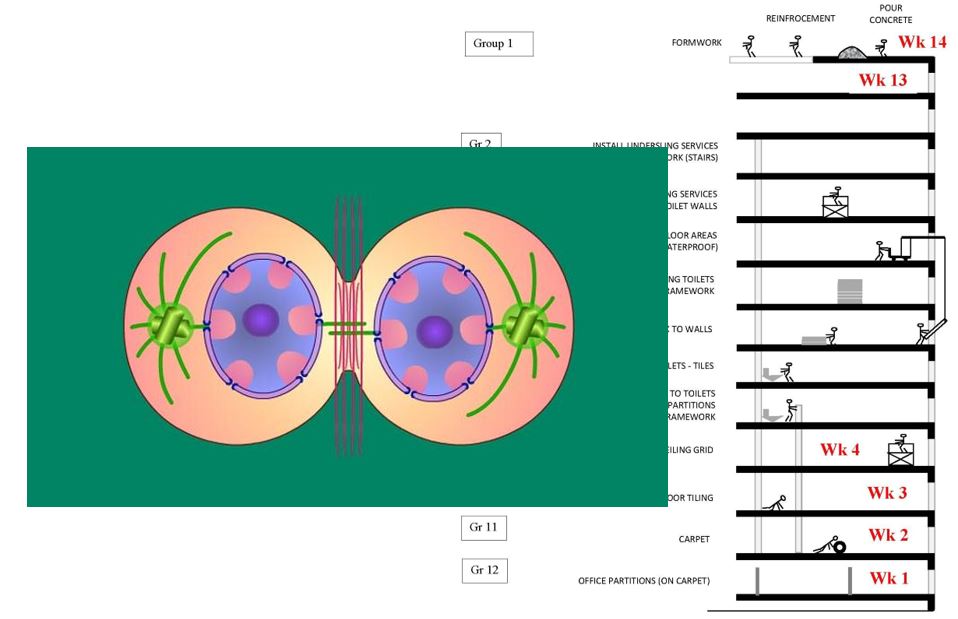
Construction as Biological Cells is an exploratory study that extends my earlier work on Brickwork as Chaos by drawing inspiration from biological cell theory to rethink how construction projects can be planned, managed, and delivered.
Using simile and metaphor, the paper views construction not as a linear sequence of activities, but as a cell-based system composed of repeatable units – physical, operational, and managerial – much like biological cells forming complex organisms. Biological cells achieve astonishing levels of accuracy through an embedded design, a stable rate of growth, and a rigorous control mechanism that arrests growth when defects are detected. The study asks a simple but profound question: what can construction learn from this?
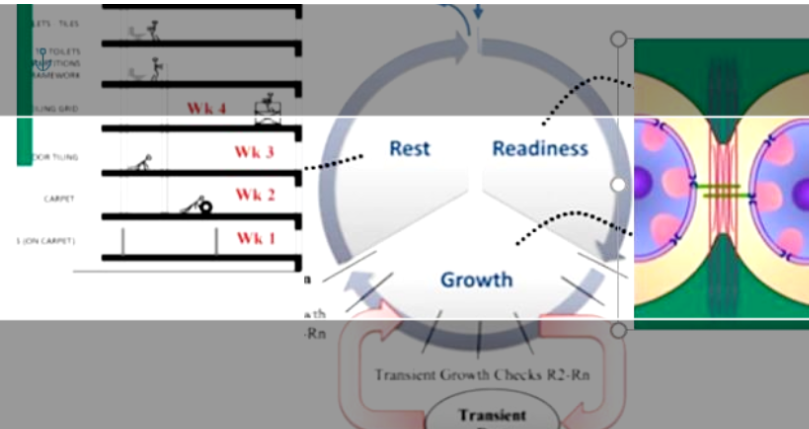
By reflecting on biological cell behaviour, the paper proposes that construction activities can be organised as “cells” with clearly defined embedded designs, uniform growth rhythms, and readiness checks. From this synthesis emerges the Readiness–Growth–Rest (RGR) model, a conceptual alternative to the widely used Plan–Do–Check–Act cycle. In the RGR model, work proceeds only when readiness is assured, growth is carefully monitored, and activities are deliberately paused when instability or non-conformance arises – mirroring the way biological cells protect the integrity of the whole organism.
The paper does not claim that construction is a biological system, but shows how metaphor can illuminate complex realities that resist purely mechanistic control. By borrowing ideas such as embedded design, controlled replication, rhythm, and gated checks, Construction as Biological Cells opens a new way of thinking about production management, quality, and reliability in construction – one that works with complexity rather than against it.
Brickwork as Chaos
Brickwork as Chaos was my doctoral study and the starting point of a longer intellectual journey into the use of metaphor as a way of understanding and navigating complexity in construction and management.
The research emerged from a simple but unsettling observation: brickwork practice in Sri Lanka operated in a condition of persistent variability. Brick sizes, joint thicknesses, wall widths, workmanship, materials, costs, and site decisions rarely conformed to standards. Conventional thinking framed this as a problem to be eliminated. My study took a different path; it asked whether this apparent disorder could be understood, worked with, and even transformed into advantage.
The metaphor of chaos proved decisive. Not chaos as randomness, but as a dynamic, non-linear condition shaped by culture, craft, economics, and human judgement. Through this lens, brickwork was no longer treated as a collection of defective components, but as a living system in which practitioners continuously adapted to uncertainty.
Using field studies, case analyses, and empirical modelling, the research revealed how bricklayers, designers, and contractors already navigated this chaos through tacit rules, flexible practices, and situational decision-making. This insight enabled a conceptual shift – from focusing on bricks and joints to understanding the wall as an adaptive system capable of absorbing variation.
From this emerged a practical framework for finding a way through chaos:
-
accepting variability rather than denying it,
-
identifying patterns of order within disorder,
-
replacing rigid standardisation with decision rules and general specifications, and
-
recognising cost, productivity, and constructability as interdependent behaviours rather than isolated variables.
The outcome was what the study described as “orderly chaos” – a state in which complexity is not suppressed, but structured just enough to allow sound judgement, efficiency, and resilience.
Brickwork as Chaos did more than address a construction problem. It demonstrated the power of metaphor as a cognitive tool – a way of synthesising fragmented realities into coherent understanding. This doctoral work became the foundation for later explorations into metaphor across construction management, leadership, cost, teamwork, and professional practice, where complex human systems resist purely linear solutions.
In this sense, Brickwork as Chaos was not an endpoint, but a beginning:
a first encounter with the insight that many of our hardest problems are not solved by imposing order, but by learning how to think, decide, and act wisely within complexity.
Other applications – Construction as Astrology?
Keep visiting this site for more – particularly those from India?
Does the concept of Construction Astrology appeal to you? If it is a research-led institution like a university, you may wish to get in touch with Dr Vasanth Abeysekera
Student as Project Manager
Student as Project Manager reframes university study through a metaphorical lens, treating the student not merely as a learner, but as the project manager of their own education. This paper shows how a deliberate metaphorical pursuit – linking project management and study management – enabled the synthesis of a practical and effective approach to student success.
Drawing on project management principles, the study positions a course of study as a temporary endeavour with a defined start and finish, governed by scope, milestones, time constraints, and success criteria. Through this metaphor, concepts normally reserved for construction and engineering projects are translated into the student context in a way that is intuitive, actionable, and empowering.
At the core of the approach is the REST framework, synthesised by Dr Vasantha Abeysekera, which places scope at the centre of success. To make scope visible and manageable, the study introduces a personalised milestone-based time plan, presented as an editable bar chart integrating all courses, assessments, weightings, and due dates. This tool encourages students to move away from ad-hoc study habits toward strategic planning, sequencing, and reflection.
Empirical findings demonstrate that students perceive the project-style milestone plan to be more useful than conventional calendar tools, particularly for understanding workload, anticipating pressure points, and prioritising effort. More importantly, the metaphor itself proved transformative: by seeing themselves as project managers, students developed greater ownership, discipline, and confidence in managing their studies.
The paper illustrates how metaphor can function as a bridge between domains, enabling knowledge transfer from professional practice to education. In doing so, it reinforces a recurring theme across Dr Abeysekera’s work – that complex human activities are often best understood and improved not through rigid prescriptions, but through thoughtful metaphors that synthesise structure, judgement, and lived experience.
For further details, see papers published by Dr Abeysekera (at least three on this topic)